Box Truck Maintenance: What It Costs and What the Law Requires
What the maintenance rules actually require, what a year on a box truck costs, and how to price it per mile instead of per repair.
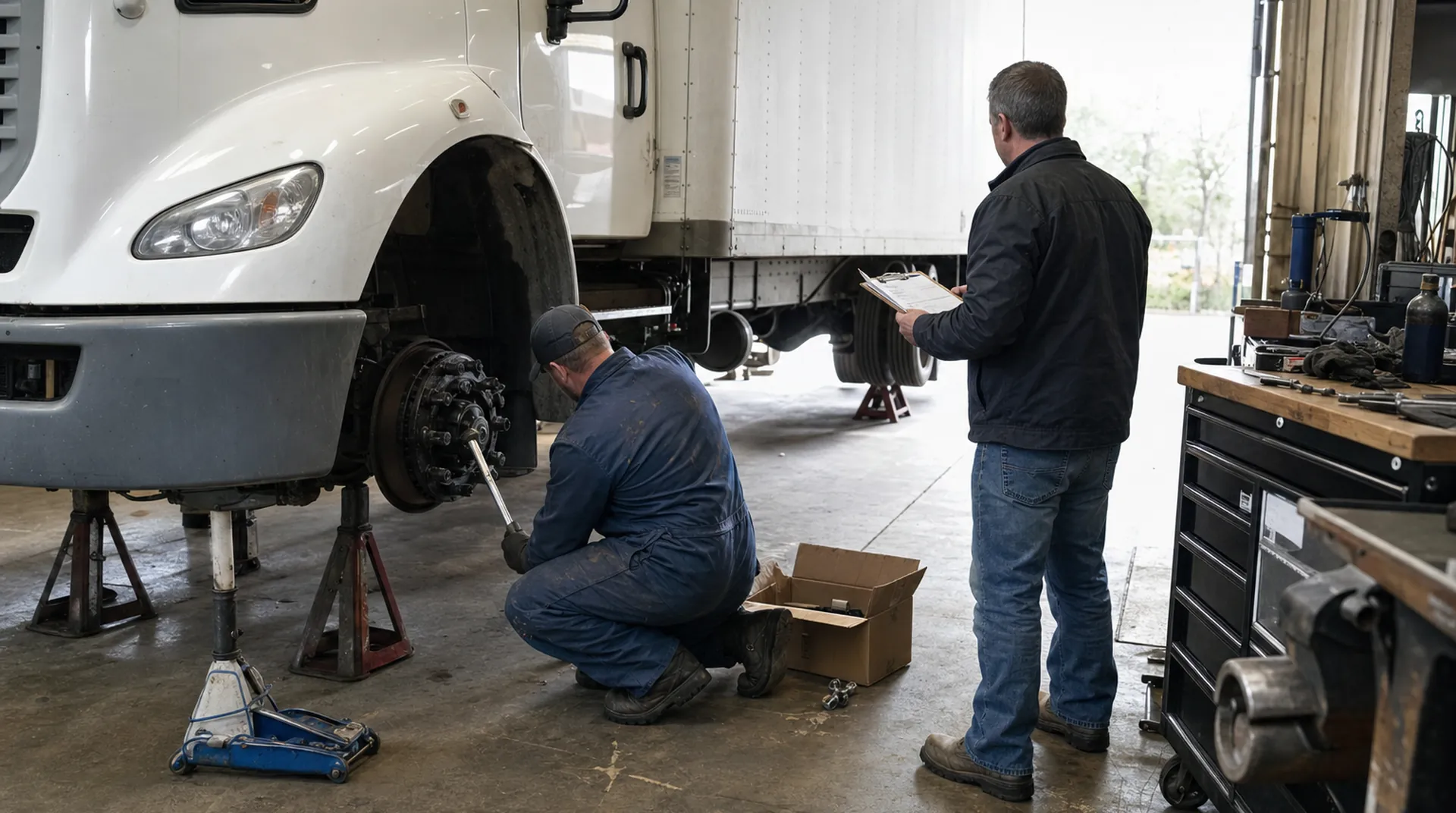
Maintenance cost per year is everything you spend keeping the truck legal and moving over twelve months: scheduled service, tyres, brakes, the annual inspection, and the repairs you did not plan for. It is not one bill and it does not arrive evenly. Most of it is predictable, a fifth of it is not, and the part owners get wrong is almost always the part the law already told them to budget for.
What does the law require you to spend on?
A programme, not a habit. Under 49 CFR 396.3(a) every motor carrier must systematically inspect, repair and maintain its vehicles, and keep parts and accessories in safe and proper operating condition at all times. “Systematically” is the operative word: fixing things when they break does not satisfy it.
The records are specified too. For any vehicle you control for 30 consecutive days, 49 CFR 396.3(b) requires you to hold the vehicle identification, the nature and due date of each inspection and maintenance operation, and a record of what was actually inspected, repaired or maintained, with dates. You keep those records for one year, and for six months after the truck leaves your control, under 49 CFR 396.3(c). That applies to a single-truck operation exactly as it applies to a fleet.
Then the annual. 49 CFR 396.17 requires every commercial vehicle to pass a periodic inspection covering at minimum the components listed in appendix A to part 396, at least once in the preceding 12 months, and the documentation has to travel on the vehicle – either the inspection report or a sticker showing the inspection date, where the report is kept, the vehicle identification and the certification. You may do the inspection yourself under 396.17(d), but only if the inspector qualifies under 49 CFR 396.19: understands part 393 and the appendix A criteria, has mastered the methods and tools, and has either completed a Federal or State sponsored programme, holds a State or Canadian Province certificate, or has training and experience totalling at least one year. For most owner-operators that means paying a shop, and it means budgeting the re-inspection when something fails.
What has to happen every day, and who pays for it?
The daily inspection is the cheapest maintenance you will ever do, and it is the part that decides how large the annual bill gets. 49 CFR 396.11(a)(1) requires a written report at the completion of each day’s work covering service brakes including trailer brake connections, parking brake, steering mechanism, lighting devices and reflectors, tyres, horn, windshield wipers, rear vision mirrors, coupling devices, wheels and rims, and emergency equipment.
Two details owners miss. Under 396.11(a)(2)(i) no report is required on a day when no defect or deficiency is found, which is why the paperwork feels lighter than the rule sounds. And under 396.11(a)(3), once a defect likely to affect safe operation is listed, the carrier must repair it and certify the repair before the vehicle is operated again. That is a stop, not a note. Reports and certifications are kept three months under 396.11(a)(4).
Before driving, 49 CFR 396.13 requires the driver to be satisfied the vehicle is in safe operating condition, review the last report where one was required, and sign to acknowledge the review. Electronic format is allowed under 49 CFR 390.32, and the section was last amended at 91 FR 7896 on 19 February 2026. A free app satisfies this. The cost here is fifteen minutes a day, and it is the line item that keeps the unscheduled column small.
What makes up a year of maintenance on a box truck?
Five groups, and they behave differently:
- Scheduled service. Oil, filters, fluids, greasing, on the interval in your manufacturer’s schedule rather than on a round number of miles. Predictable, and the one line you can quote in advance.
- Tyres. Bought as a set, not as a tyre. Budget them by expected life in miles, divide across the year, and put the money aside monthly. A box truck that goes through one set a year and one that goes through one every two years have very different annual figures and identical monthly ones if you do this.
- Brakes and wear items. Mileage driven, and the first thing an inspector looks at.
- The annual periodic inspection. Fixed date, variable cost, because the inspection is cheap and what it finds is not.
- Unscheduled repair. Unpredictable in timing, not in existence. Over a full year it is not an accident, it is a line.

Know Your Costs? Find Loads That Cover Them.
Vic’s gives box truck owner-operators their own dispatcher and pays weekly. Apply in about a minute.
Apply to drive with Vic’s →What does the published industry number tell you?
Direction, not your figure. The American Transportation Research Institute’s Analysis of the Operational Costs of Trucking, published 15 July 2026 for data year 2025, puts the industry average cost to operate a truck at $2.336 per mile, up 3.4 percent, and $1.854 per mile excluding fuel, up 4.2 percent.
Useful as a trend, weak as a benchmark for you. ATRI’s public summary does not state which vehicle classes its sample covers, and a straight box truck is not the same machine as the tractor-trailers that dominate most industry cost surveys. Read it as evidence that maintenance costs are rising, not as a target to measure your own truck against.
How do you work out your own annual figure?
Same method as every other number in this business. Take twelve months of maintenance spend from your bank and card statements, including the annual inspection and anything you paid a shop, and divide by total odometer miles for the same twelve months. That gives you maintenance cost per mile, which slots straight into your box truck cost per mile as its own line.
If you do not have twelve months yet, use what you have and mark it provisional. Three months of real spend beats a year of estimates, as long as you remember that three months without an annual inspection or a tyre set in them is not a year in miniature.
Then reverse it. Multiply your maintenance cost per mile by the miles you expect to drive next year, and that is the number to fund monthly rather than to find when the truck is already in the shop.
What do owners underbudget?
- Downtime. The days the truck is in the shop still carry the payment, the insurance and the permits. A three-day repair costs the repair plus three days of fixed cost plus the revenue you did not earn.
- The inspection failing. The annual is a pass or fail event, and the budget has to cover the fail. Owners fund the inspection and not the outcome.
- The end of the warranty. A truck bought new has an artificially low maintenance year one and a real one in year four. If you set your rate floor on year one, year four will find you.
- The reserve. Money set aside for the next major repair is not this month’s bill, so it is the first thing dropped in a slow month and the reason a slow month turns into a lost truck.
Where to start
Open a separate account, move a fixed amount into it after every settlement, and pay every maintenance bill out of that account only. Within a quarter the balance tells you whether the amount is right, and you will never again be deciding between a repair and a mortgage payment in the same week.
Then put the records where the rule expects them. A folder with the last twelve months of service, the annual inspection report and your daily reports satisfies 49 CFR 396.3 and 396.11, and it is also what a buyer will ask for when you sell the truck.
If you are pricing the whole operation rather than one line of it, start with box truck cost per mile, and see what the second largest fixed cost is doing in our guide to box truck insurance.
The fund only refills if the truck keeps earning between services, so check our current box truck freight loads for the work that pays for it.