Expedited LTL vs Full Truckload: Which One Do You Actually Need?

When a shipment is time-critical, the usual LTL-versus-truckload math changes. It stops being about how much space you fill and starts being about how many stops stand between your freight and the deadline.
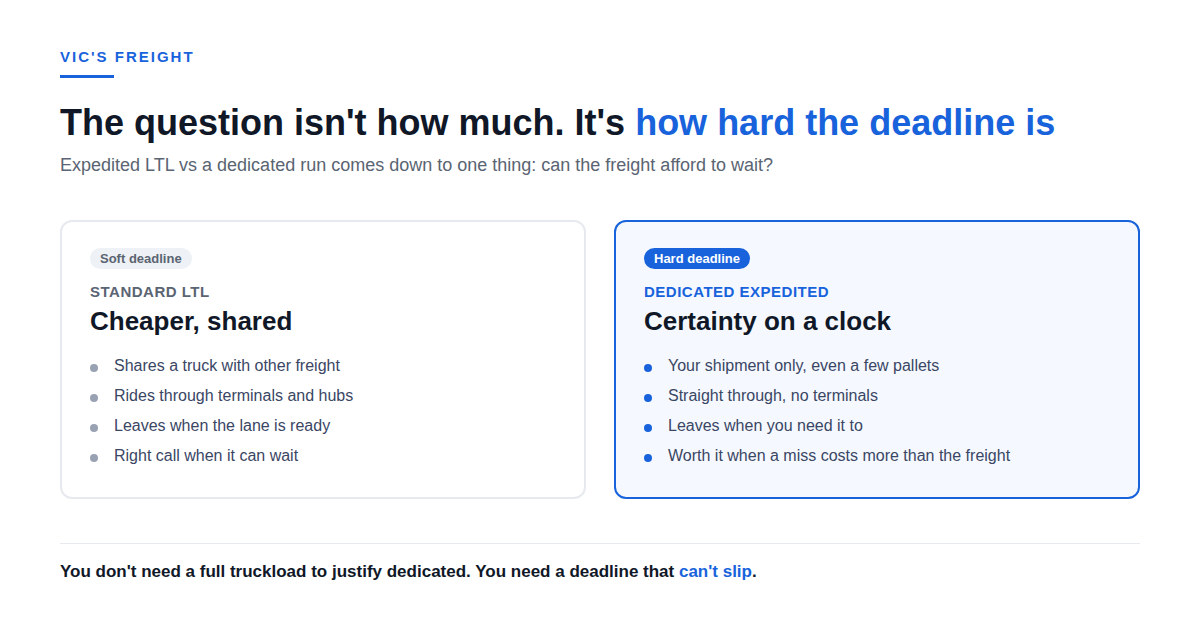
That is the real difference. Standard LTL is cheap because your freight shares a truck and rides through terminals. When the clock is hard, every one of those stops is a place the shipment can wait.
Why standard LTL struggles under a deadline
LTL works by consolidation. Your pallets share space with everyone else’s, move through hubs, and get re-handled along the way. Most of the time that is fine and it is cheaper, so you should use it. But the same consolidation that makes it cheap is what makes it unpredictable when timing matters: the truck leaves when the lane is ready, not when you need it to, and a delay anywhere in the network is a delay for you.
Think about what actually happens to a pallet in the LTL system. It gets picked up. It rides to an origin terminal. It waits for a linehaul truck going the right direction. It rides to another terminal. Sometimes it rides to a third. Then it goes out for delivery. Each of those handoffs is a queue, and each queue moves on the carrier’s schedule, not yours. When volume is heavy, the queue gets longer. When weather hits one hub, the freight behind it backs up too. None of that is a failure of LTL. It is how the network is built to keep costs low.
The re-handling is the other quiet risk. Every time a forklift touches your freight, there is a chance it gets set down in the wrong spot, mislabeled, or damaged. On a soft delivery date, a lost day gets absorbed and nobody notices. On a hard date, a single missed connection at one terminal is the whole problem. You do not find out until the freight is already late, and by then there is nothing to do but call and apologize.
When a dedicated run beats filling a truck
Expedited freight flips the model. A vehicle is assigned to your shipment and drives it straight through, no terminals, no shared load. The surprise for a lot of shippers is that you do not need a full truckload to justify it. A few pallets on a dedicated van or box truck can beat full-truckload pricing logic when the alternative is a missed window, because you are buying certainty on a specific clock, not space you do not need. Which vehicle fits comes down to size and how it loads, not just weight, and we get into that in the guide to choosing a cargo van, sprinter, or box truck.
What you are really paying for is a straight line. The freight is loaded once and unloaded once. Nothing sits in a queue. The driver is on your lane and only your lane, so the transit time is close to what a map says it should be instead of what a terminal schedule allows. That predictability is the product. When a line goes down, a customer is waiting on a part, or a penalty clause is attached to the delivery, the value of knowing exactly when the freight lands is worth more than the money you would save sharing a trailer.
Dedicated also gives you a real answer when something changes en route. One shipment, one driver, one point of contact. If the receiver moves the appointment or you need a status, there is a person who knows exactly where your freight is. In the LTL network that same question means tracing a pallet across terminals that each have their own clock.
How to make the call
- If the date is soft and the freight can wait, standard LTL is the right, cheaper choice.
- If the date is hard and a miss costs more than the freight, a dedicated expedited run removes the terminals and the shared-load risk.
- If you have a full truckload and a deadline, dedicated truckload is straightforward. The interesting case is partial loads that still cannot afford to wait.
Run it as one question before you book. What does a late delivery actually cost you. If the honest answer is a mild inconvenience, ride the standard network and save the money. If the answer is a stopped line, an angry customer, a penalty, or a lost account, the freight is not really the expense anymore. The deadline is. Price the miss, not the pallets, and the mode usually picks itself.
Two things trip people up here. The first is assuming a small shipment has to go LTL because it is small. Size is not the deciding factor, the deadline is. The second is treating the sticker price of a dedicated run as the whole cost, when the real comparison is that price against what a blown window does to the rest of the job. The question is not how much you are shipping. It is what a late delivery costs, which is the same tradeoff behind what drives the cost of expedited freight.
Where Vic’s fits
Vic’s runs dedicated expedited across the US and Canada in vehicles sized from cargo van to straight truck, each assigned to a single shipment and driven straight through. When a partial load cannot ride the standard network and wait, that is exactly the gap we fill: dedicated capacity without needing to fill a whole trailer.
Get an instant quote. Tell us the freight and the deadline, and we will tell you whether a dedicated run makes sense over LTL.