Liftgate Delivery: When Your Freight Needs One
Short answer
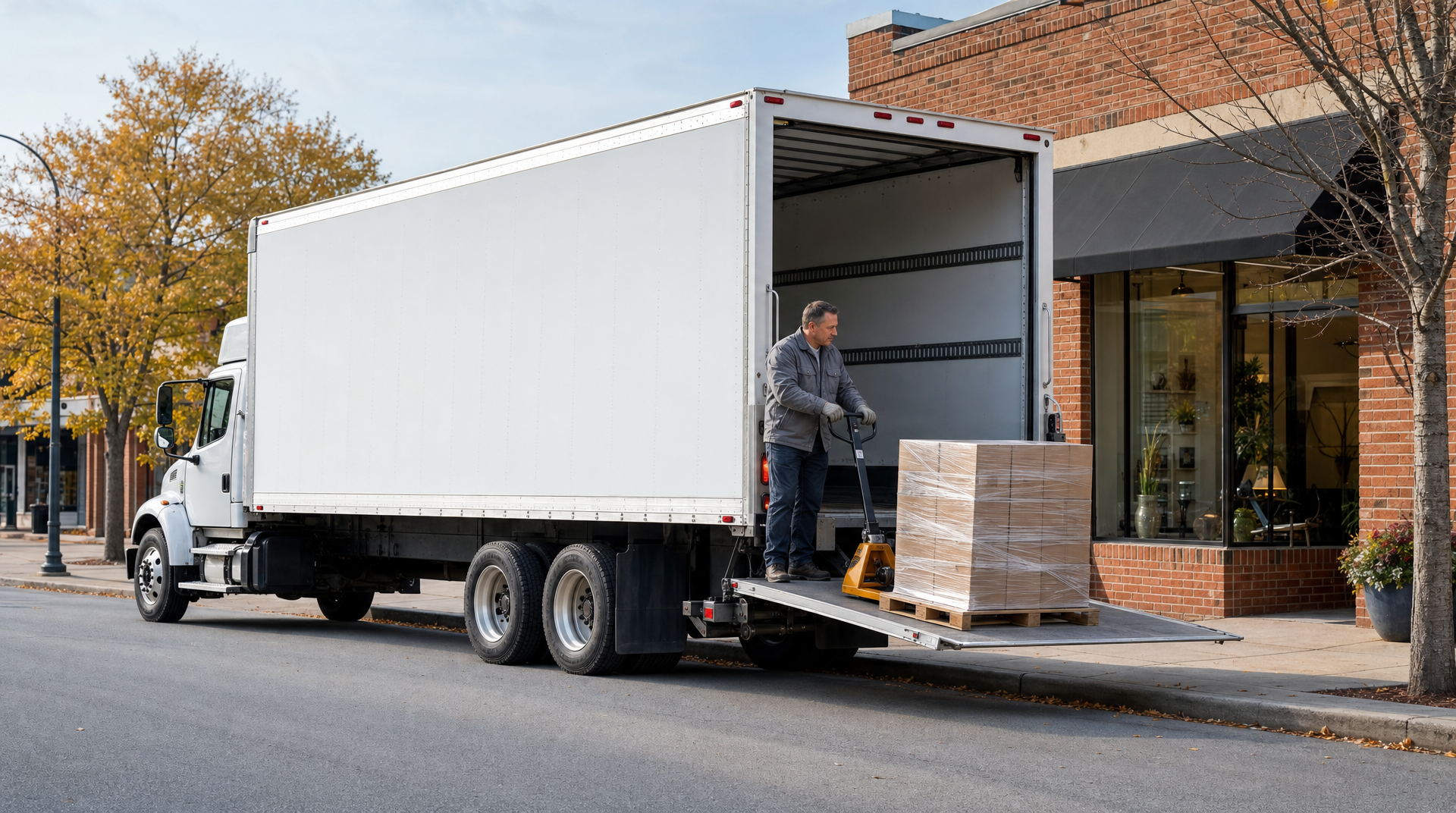
Liftgate delivery means the truck uses a powered platform at its rear to lower your freight from the cargo floor to the ground. You need it when the delivery address has no loading dock and no forklift: a storefront, a home, a job site, a church, a farm. It is an extra service with its own charge, it has weight and size limits per piece, and the carrier is not obliged to provide it if no equipped truck is free. So ask for it when you book, not when the driver calls from the curb.
Your freight is on pallets. The place it is going has a front door, a parking lot and maybe a garage, but no dock and nobody with a forklift. How does a pallet get from the back of a truck to the ground?
Usually with a liftgate. Here is what liftgate delivery is, when your shipment needs one, when it does not help, how it differs from inside delivery, and what to tell the carrier so the right truck shows up.
Liftgate delivery at a glance
| Question | Short answer |
|---|---|
| What it is | A powered platform at the rear of the truck that lowers freight to the ground, or raises it at pickup |
| When you need it | No dock and no forklift at pickup or delivery |
| Typical places | Shops, homes, job sites, schools, churches, farms, storage units |
| What it does not do | Carry freight inside, up stairs or across the property |
| Limits | Weight and size per piece, set by the gate and the carrier’s rules |
| When to ask | At booking. Not every truck has a gate |
| Who pays | Usually the party paying the freight charges, on top of the line haul |
| Urgent freight | Some LTL carriers drop their delivery guarantee on liftgate deliveries |
What is liftgate delivery?
A liftgate is a hydraulic or electric platform mounted at the back of a truck. At a dock, freight rolls straight from the trailer floor onto the dock floor at the same height. Without a dock, the cargo floor is well above the ground, and something has to close the gap. The liftgate does that: the pallet is rolled onto the platform, the platform lowers to the ground, and the pallet is rolled off.
Carriers treat it as an accessorial, an extra service listed in their rules tariff. TForce Freight’s rules tariff describes it as the carrier being “required or requested to employ mechanical loading or unloading devices, including hydraulic or electric lifting or lowering devices, to accomplish pickup or delivery.” The charge applies separately at pickup and at delivery, so a move with no dock at either end can carry it twice.
When your freight needs a liftgate
The test is simple: at each end of the move, can the freight get off the truck without one? If there is a dock or a forklift and someone to drive it, you do not need a gate. If there is neither, you almost certainly do. The common cases:
- Retail and small commercial addresses. A storefront, a restaurant, a small office or a clinic with a front door and a parking space, but no dock.
- Homes. Residential delivery usually means the freight goes to the ground floor entrance, the garage or the carport. TForce Freight’s tariff spells out exactly those three spots for residences.
- Job sites. A construction site may have a forklift some days and none on the day your freight arrives.
- Limited access locations. Carriers keep a list. TForce Freight’s includes churches, restaurants, schools with no loading dock, farms and ranches, hospitals, golf courses and mini storage units. Many of them have no dock, and they often carry their own surcharge on top of the liftgate.
- Pickup from a site with no dock. The same logic runs in reverse when a gate is needed to lift freight onto the truck.
If you are not sure, call the receiver and ask three questions: is there a dock, is there a forklift, and will someone be there to run it when the truck arrives? A “yes, usually” to the last one is a no.
When a liftgate is not the answer
A liftgate solves a height problem. It does not solve every unloading problem.
- The piece is too heavy for the gate. Gates are rated by model. TForce Freight says its liftgate service “may not be provided when the weight per handling unit exceeds 2,000 pounds, if the service cannot be performed safely.”
- The piece is too big for the platform. The same tariff sets size thresholds per handling unit as it would sit on the gate: over 70 inches long, 72 inches high or 48 inches wide.
- The freight cannot be rolled. The gate lowers the freight. Moving it on and off the platform still needs a pallet jack or a hand truck, so loose or awkward pieces may need to be palletized or crated first.
- The truck cannot reach the spot. A gate needs a reasonably level, open space behind the truck. TForce Freight renders the service only “at locations that are safe and accessible to the vehicle,” and residential deliveries also depend on local rules on truck size and weight.
For a piece over the limits, the usual options are a forklift arranged on site, rented equipment, or a delivery address that does have a dock. If the carrier has to rent equipment to do the job, TForce Freight’s tariff puts that cost on the customer.
Liftgate vs inside delivery
This is where most surprises happen. A liftgate gets your freight to the ground behind the truck. It does not get it into the building.
Carriers treat moving freight beyond the tailgate as a separate service. In TForce Freight’s tariff, delivery to “positions beyond the immediate adjacent loading or unloading positions,” which covers inside delivery, is its own item with its own charge, and the carrier may do it “when requested by shipper or consignee and operating conditions permit.” Hand unloading off the truck to the ground is a separate item again.
So if the pallet has to end up in a back room, a basement or a second floor, ask for liftgate and inside delivery together, and say where the freight has to end up. If the booking says liftgate only, a pallet left on the sidewalk is the service you bought.
Types of liftgates
You rarely get to choose the gate, but knowing the main types explains why one truck can do a job and another cannot. Manufacturer Maxon groups its gates into a few families:
- Conventional gates, where the platform is stored against the rear door or becomes the door itself. Maxon pitches them for the largest platform sizes.
- Tuck-under gates, where the platform folds and stows under the truck body, leaving the rear open so the same truck can still back into a dock.
- Rail gates, built for medium and heavy-duty trucks, and slide-away gates that store flat under the body.
- Column lifts, Maxon’s top-spec family.
Capacity and platform size differ by model, which is why the carrier needs the real weight and dimensions of each piece, not a guess.

No Dock at Delivery?
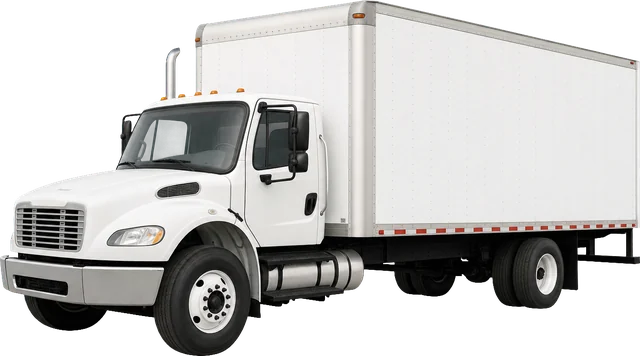
Vic’s runs cargo vans to straight trucks across the US and Canada, one shipment per vehicle, and box trucks with a liftgate are available. Send the pieces, weights, dimensions and both addresses.
Get an instant quote →Why you have to ask when you book
Not every truck has a gate, and the carrier is not obliged to find one at the last minute. TForce Freight’s tariff says the carrier “is not obligated to perform such service when suitable vehicles equipped with such devices and operators are not available.” If the request is not on the booking, the truck that shows up may simply be one without a gate.
The request also changes the price and the paperwork. The charge is usually “paid by the payer of the freight charges,” and it is easier to agree on it at booking than to argue about it on the invoice. Put it on the bill of lading so the delivering driver sees it too.
Liftgates and delivery guarantees
If the freight is urgent, check what a liftgate does to your service level. TForce Freight lists “Lift gate deliveries” among the conditions under which its guaranteed LTL services do not apply, alongside limited access delivery points. You can book the gate or the guarantee on that service, but not both.
That matters most when a shared LTL network was never the right fit for the deadline. For how guaranteed LTL compares with a truck that carries only your shipment, see expedited LTL vs guaranteed LTL vs dedicated.
Three liftgate situations
Two pallets of fixtures for a new shop. The address is a storefront on a main street, with a front door and a loading zone out front. No dock, no forklift. The shipper books liftgate delivery, gives the carrier the weight and size of each pallet, and asks the store to have a clear path from the curb to the door. The pallets come off on the gate and get rolled in by hand.
A crated machine going to a home workshop. One crate, heavier than the carrier’s per-piece limit for the gate. A liftgate request alone could end with the unload refused at the curb. The buyer arranges for a forklift to be rented and on site at the delivery window, and the carrier is told that the gate is not needed but the address is a residence.
Materials for a job site. The site has a telehandler, but it moves around the site and the operator is busy. The shipper books a truck with a liftgate as a backup and names a site contact who will meet the driver. If the forklift is free, the gate is not used. If not, the delivery still happens.
The pattern in all three: decide how the freight comes off the truck before it goes on.
What to tell the carrier
- Liftgate at pickup, at delivery or both.
- Each piece: weight, length, width and height, and whether it is on a pallet, in a crate or loose.
- The address type: business with a dock, business without a dock, residence, job site or another limited access location.
- Where the freight has to end up: at the tailgate, inside the door, or further in.
- Site details: parking, slope, gravel or grass behind the truck, height or weight limits on the street.
- A contact at each end who will be there when the truck arrives.
If the freight is moving in a box truck or straight truck, straight truck vs tractor-trailer covers when the smaller truck is the better booking, and cargo van vs sprinter vs box truck covers which vehicle fits your pieces.
What you can control
- The request. Put the liftgate on the booking and the bill of lading, at each end that needs it.
- The numbers. Real weights and dimensions per piece. Check them against the gate limits before you book.
- The packing. Palletize or crate pieces so they can be rolled onto the gate and handled with a pallet jack.
- The last few feet. If the freight has to go inside, ask for inside delivery as well, or have people ready to move it.
- The receiver. Make sure someone is there, the space behind the truck is clear, and they know what is coming.
- The deadline. If the freight is urgent, confirm that the liftgate does not cancel the delivery guarantee you are paying for.
A liftgate is a small piece of equipment that decides whether a delivery happens on the first try. The freight gets off the truck one of three ways: a dock, a forklift or a gate. Pick which one before pickup, tell the carrier, and the truck that arrives will be able to do the job. If the shipment also cannot wait or share a truck, Vic’s runs cargo vans, sprinters, box trucks and straight trucks, one shipment per vehicle, and box trucks with a liftgate are available. Get an instant quote and tell us the pieces, weights and dimensions, both addresses, whether you need a liftgate at either end, and when it has to arrive.