Scaling From One Box Truck to Two: What Actually Changes
Why the second truck is a compliance decision before it is a money one, and the four tests that say the first one is ready.
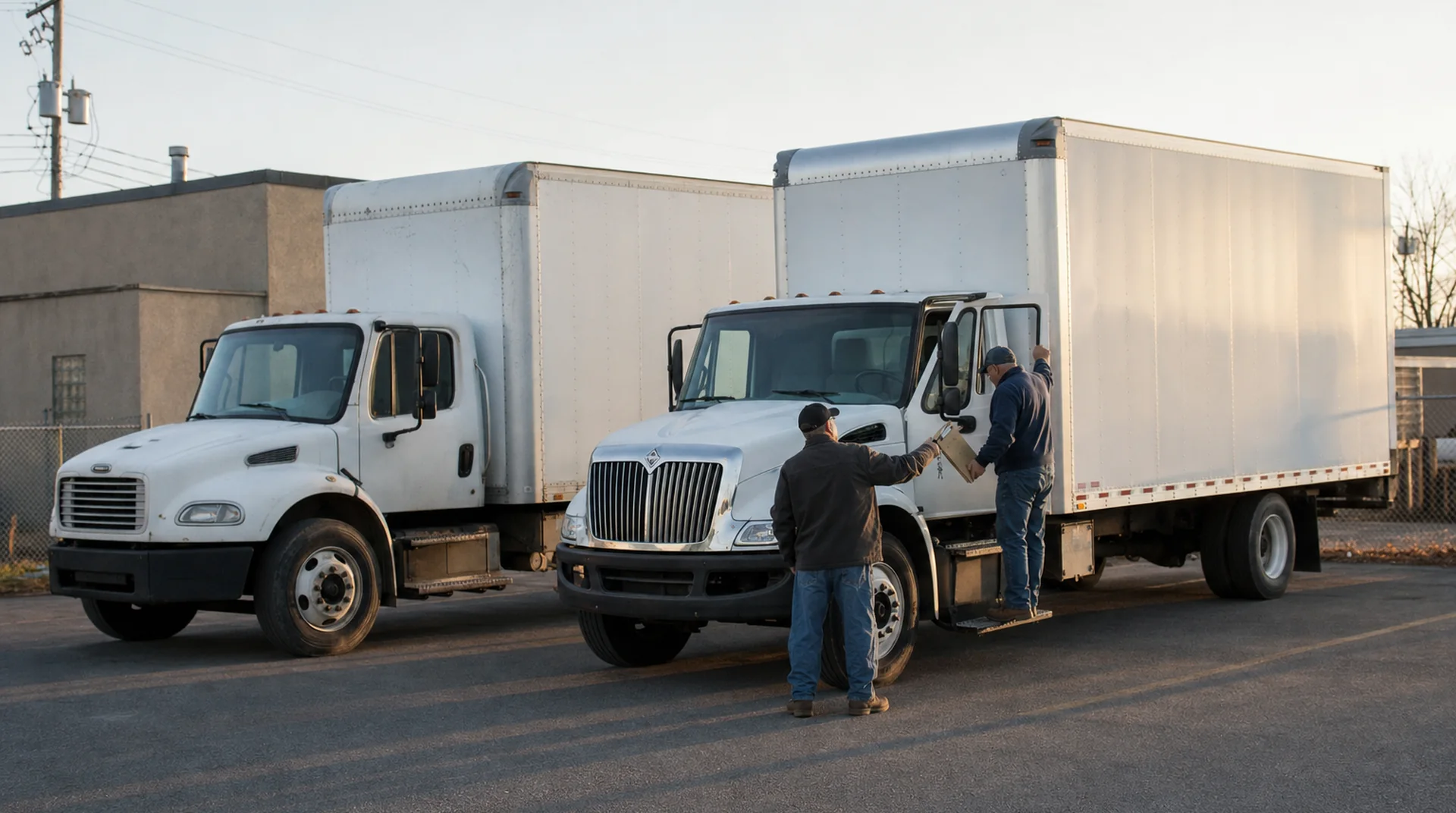
Adding a second box truck is not buying another truck. It is becoming an employer and a fleet, and almost everything that made one truck work – you drive it, you inspect it, you know where it is – stops being available the moment there are two. The purchase is the cheapest part of the decision and the part owners spend the most time on.
What actually stops most owners at one truck?
Not money. The constraint that bites is that a one-truck operation runs on the owner being in the cab, and every hour spent finding freight, invoicing, chasing paperwork and arranging repairs is an hour the truck is not moving. Add a second truck and that administrative load roughly doubles while your available hours do not move at all.
So the real question is not whether you can afford the truck. It is whether you can stop driving enough to run two, or afford to pay someone to drive both while you do. Owners who skip that question end up with two trucks, one of which is parked while its driver waits for a load nobody had time to book.
What changes on your registration and your insurance?
Your authority already covers more than one vehicle, so you are not re-applying. What you are doing is updating the record and the cover.
- Your carrier record. Vehicle and driver counts sit on your MCS-150, and 49 CFR 390.19T requires that report to be updated every 24 months on a schedule set by the last digit of your USDOT number. Failing to update it carries penalties and deactivation of the USDOT number, which stops both trucks rather than one.
- Your insurance. The federal minimum under 49 CFR 387.9 is a minimum per vehicle, not per company, so the second truck has to be scheduled and the filing kept current. What moves the premium is covered in our guide to box truck insurance, and a second unit with a hired driver moves it in more than one direction.
- Your maintenance programme. 49 CFR 396.3 requires systematic inspection and records for each vehicle you control, and 49 CFR 396.17 requires each one to pass an annual periodic inspection. Two trucks means two record sets and two inspection dates, and the second truck’s schedule will not conveniently match the first.
What has to be done before a hired driver turns a wheel?
This is where the timeline actually lives, and it is longer than people expect. A driver must be qualified under 49 CFR 391.11(b) before you permit them to drive: at least 21, able to read and speak English sufficiently for the job, able by experience or training to operate the vehicle safely, physically qualified under the medical rules, holding one valid licence from a single jurisdiction, not disqualified under 49 CFR 391.15, and holding a road test certificate under 49 CFR 391.31 or an accepted equivalent.
You must also open a driver qualification file. 49 CFR 391.51 sets out what goes in it, including the employment application, the motor vehicle record from each licensing authority, the road test certificate, the annual driving record inquiry, the note of your annual review of that record, and the medical examiner’s certificate.
Then the testing. Under 49 CFR 382.301(a) a driver must undergo pre-employment controlled substances testing and you must have received a verified negative result before allowing them to perform safety-sensitive functions. Separately, 49 CFR 382.701(a) requires a full pre-employment query of the Drug and Alcohol Clearinghouse, with the driver’s specific consent, before you employ them.
None of this is optional and none of it happens in a day. Start it before the truck arrives, not after.

Need Freight for a Second Truck?
Vic’s works with box truck owner-operators nationwide and pays weekly. Apply in about a minute.
Apply to drive with Vic’s →What starts and never stops once you have a driver?
The recurring obligations are the ones that catch single-truck owners out, because nothing prompts you and the consequences arrive at an audit rather than at the time.
- A random testing programme. Most one and two truck carriers meet this by joining a consortium rather than running their own.
- An annual Clearinghouse query for every driver subject to testing, under 49 CFR 382.701(b). A limited query satisfies it, but if that limited query shows information exists you must run a full query within 24 hours.
- The annual driving record inquiry and review, which goes back into the qualification file each year.
- Payroll, or a contract. A hired driver is either an employee, with everything that implies, or an owner-operator leased to your authority. The second arrangement changes who owns the truck and who pays for fuel. It does not move the driver qualification and testing duties off you, because they attach to the carrier whose authority the driver runs under.
Does a second truck double your income?
It roughly doubles your fixed costs on day one and adds revenue only as fast as you can keep it loaded. The payment, the insurance, the permits and the reserve all start immediately. The freight does not.
It also changes the arithmetic rather than scaling it. Your cost per mile is now an average across two trucks with different ages, different maintenance profiles and different utilisation, and the weaker truck hides inside the average. Calculate it per truck, not per company. The method is the same one in our guide to box truck cost per mile, run twice.
The honest version is that a second truck driven by someone else earns a margin, not a wage. If the first truck’s margin is thin because you are paying yourself out of it without noticing, the second truck will simply make that visible at twice the size.
When are you actually ready?
Four tests, and they are all about the first truck rather than the second:
- You know your cost per mile per truck and it has been stable for two quarters.
- You are turning down freight you could have covered, repeatedly, from customers who keep asking.
- You have a cash reserve that covers the second truck’s fixed costs for the months before it is busy, plus a major repair on either unit.
- Your compliance paperwork is already clean on one truck. Two trucks do not fix a records habit, they expose it.
Turning down freight is the one that matters most, and it has to be repeat demand rather than a good month. Buying a truck against a busy quarter is how owners end up selling one a year later.
Where to start
Before you price a truck, price a driver. Work out the fully loaded cost of the person who will drive it, add it to the fixed costs of the unit, and see what weekly revenue that combination needs. That number tells you whether the demand you are turning away is actually enough.
Then get the qualification and testing process started, because it sets the earliest date the truck can earn anything. A truck sitting on your lot waiting for a Clearinghouse query costs exactly the same as one on the road.
If you want to see what the second truck would be hauling, look at our current box truck freight loads, and at finding direct shippers for a box truck, which is the demand that makes a second unit worth owning.