Limited Access Delivery: Schools, Job Sites, Bases and Fees
Short answer
Limited access delivery is an LTL accessorial for addresses a driver cannot simply pull up to and unload: schools, construction sites, military bases, prisons, churches, storage units and similar places. In the rules tariffs we checked, the charge ran from $125 to $580 at Old Dominion, $195 at TForce Freight and $229 at FedEx Freight, on top of the freight charges. Declare it on the bill of lading so it is on the quote, not added to the invoice later.
You book an LTL shipment to a school, a job site or a base, and the quote looks fine. Then the invoice shows a line you did not expect, or the driver is turned away at the gate. Both usually trace back to one box on the bill of lading: limited access.
What is limited access delivery?
It is a pickup or delivery where access is controlled, the site is closed to the public, or there is no dock and no regular receiving. Each carrier keeps its own list.
- Old Dominion (ODFL 100-Q, Item 753-4) lists day cares, camps, military facilities, court houses, jails, prisons, parks, libraries and “any other sites requiring inspection of the driver or vehicle before permitting access.” Construction sites (Item 753-2) and schools, colleges, churches or rectories (Item 753-3) have their own items, with the same charge.
- TForce Freight (UPGF 102-T, Item 755-A) lists airports, churches, construction sites, farms, golf courses, hospitals, mini storage units, military bases, mine sites, oil fields, prisons, restaurants, schools with no loading dock, and businesses not open to walk-in customers during normal hours.
- FedEx Freight (100-Y, Item 750-8) lists storage units, places of worship, schools, construction sites, prisons, military bases, mine sites, wind farms, airports, and sites requiring security inspections before the driver can reach the loading area.
The lists overlap but are not identical. A hospital is named only by TForce Freight, so check the tariff of the carrier you are booking. Residential delivery is a separate accessorial in all three.
How much do carriers charge for limited access delivery?
| Carrier and tariff | Charge | Who is billed |
|---|---|---|
| Old Dominion, ODFL 100-Q, Items 753-2, 753-3, 753-4 | $7.20 per cwt, $125 minimum, $580 maximum | Shipper or third party on prepaid shipments, consignee on collect |
| TForce Freight, UPGF 102-T, Item 755-A | $195 per shipment, initial notification included | The party that authorized the service or the payer of the freight charges, unless the bill of lading is endorsed prepaid |
| FedEx Freight, 100-Y, Item 750-8 | $229 per shipment (US) | Not stated in Item 750-8 |
Figures are from the US sections of the ODFL 100-Q rules tariff (pages revised 10/05/2026), the TForce Freight UPGF 102-T rules tariff (Item 755-A effective August 3, 2026) and the FedEx Freight 100-Y rules tariff (effective January 5, 2026), as online on November 8, 2026. Your contract may differ.
Three details matter more than the headline number:
- It can be charged twice. Old Dominion and TForce Freight apply it separately for pickup and for delivery, so job site to job site freight can pay it at both ends.
- Old Dominion scales with weight. A 1,500 lb shipment works out to $108, so the $125 minimum applies. A 5,000 lb shipment comes to $360, and from about 8,100 lb the $580 cap applies.
- The call ahead may or may not be included. TForce Freight’s $195 includes the initial notification, and FedEx Freight’s includes it when you give the consignee’s correct phone number. Old Dominion makes its arrival notice subject to its notification and appointment item (Item 647, $30 per shipment), so ask whether that line will be added.
What happens if you do not declare it on the bill of lading?
The charge does not go away. Old Dominion’s tariff says that consigning a shipment to such a location “will be considered a request” for the service. The carrier finds out when the driver arrives, and the charge comes as an invoice adjustment.
The bigger cost is a failed attempt. If the gate needs a driver’s name in advance, or the site contact does not answer, the truck may not get in. The freight goes back to the terminal, and the next attempt is billed as a redelivery, with storage in between. We covered those charges in who pays for a missed delivery appointment.
Old Dominion asks the shipper to put the location type on the bill of lading with the “name, telephone number and full address of the party to contact to arrange delivery.” A real contact who answers the phone is part of the booking.
What restrictions should you expect at each kind of location?
Schools and colleges
Many schools have a side entrance, not a dock. Deliveries may be blocked during arrival and dismissal, and buildings close for breaks. On a campus, the delivery point may be central receiving, not the department that ordered. Ask which entrance, which hours, and whether the freight needs a liftgate. Our liftgate delivery guide covers that second question.
Construction sites
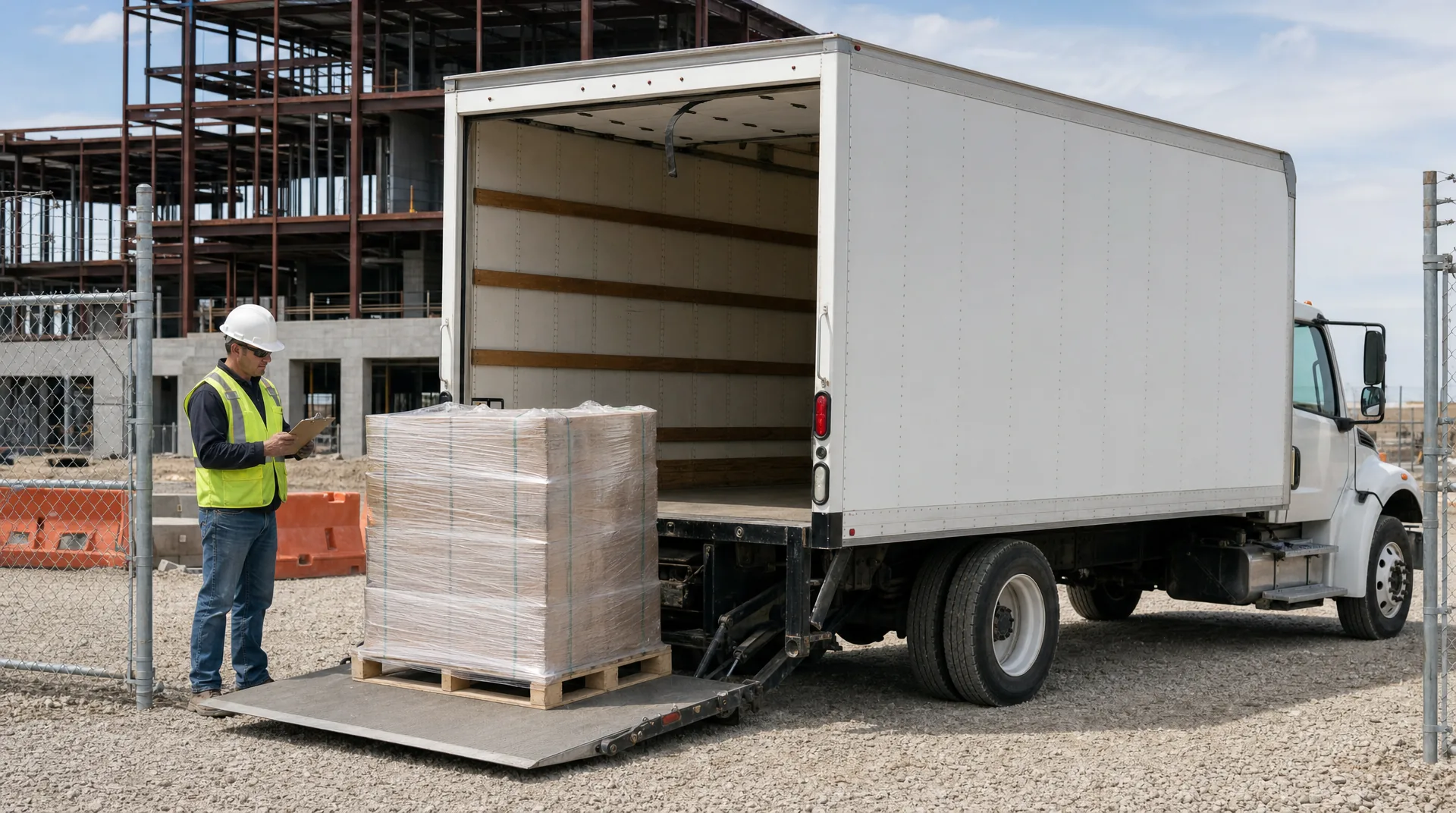
Both Old Dominion and TForce Freight count the entire property as the construction site, including warehouses or supply buildings on it. Job sites tend to have no dock, uneven ground and a forklift that is not always there, and a new build may have no street address yet. Ask for the gate location, the superintendent’s phone number and what equipment will be on hand to unload.
Military bases
Bases are on all three carriers’ lists. Commercial vehicles are usually inspected at a gate, and the driver may need to be cleared in advance. The person who ordered the freight knows the current procedure. Ask which gate handles commercial deliveries, what ID the driver needs, how far ahead the details must be submitted, and who meets the truck.

Delivering to a Gate With a Narrow Window?
Vic’s runs cargo vans to straight trucks across the US and Canada, one shipment per vehicle, with dispatch that answers 24/7. Send the pieces, the site’s access rules and the time the receiver can take it.
Get an instant quote →What should you ask the receiver before you book?
- Is there a dock? If not, is there a forklift, or does the truck need a liftgate?
- What are the receiving hours? Including closed days, such as school breaks.
- How does the driver get in? Gate, guard, keypad or escort, and which entrance trucks use.
- Is paperwork needed in advance? What driver and vehicle details, and how many days ahead.
- Who is the site contact? A name and a phone number that will be answered on the day.
- Can the receiver pick it up instead? Old Dominion waives its fee when the consignee collects at the destination terminal by the first business day after notice of arrival.
- Who pays the accessorial? On a prepaid shipment the carrier bills the shipper. If the receiver should cover it, agree that first.
When is declared LTL the right choice?
Often. If the shipment is a pallet or two, the receiver can take it on any day the carrier offers, and the site has a dock, a forklift or a booked liftgate, declared LTL is the normal way to move it. LTL is priced for shared trailer space, so on small freight it usually stays the cheaper option with the surcharge added. Declare the location, list the contact, and the charge is a known line on the quote. If the receiver can collect at the terminal, Old Dominion drops the charge entirely.
When does a dedicated box truck make more sense?
The case for a dedicated vehicle is about the delivery window and the risk of a failed attempt, not the surcharge on its own. It is worth quoting when:
- The gate needs one driver and one vehicle on a specific day. With one truck on your shipment, those details can be sent to the gate before pickup.
- A crew or a crane is waiting. A day late can leave a crew standing, and an LTL date depends on the carrier’s route.
- The site can only receive in a narrow slot, and the freight cannot sit in a terminal if the first attempt fails.
- You need a guarantee. FedEx Freight’s money-back guarantee excludes shipments “requiring delivery to limited-access delivery locations,” and TForce Freight’s guaranteed services list limited access delivery points among their exclusions. See expedited LTL vs guaranteed LTL vs dedicated for how those services compare.
A dedicated truck does not remove the gate. The driver still needs clearance, and a site with no dock still needs a liftgate or equipment to unload. What changes is that the timing and the paperwork are about one truck, planned for one stop.
Frequently asked questions
What is limited access delivery?
It is an LTL accessorial for pickups or deliveries at places with controlled access or no regular receiving, such as schools, construction sites, military bases, prisons and storage units.
How much is a limited access delivery fee?
In the rules tariffs online on November 8, 2026, Old Dominion charged $7.20 per hundred pounds ($125 minimum, $580 maximum), TForce Freight $195 per shipment and FedEx Freight $229 per shipment in the US.
Is a construction site a limited access location?
Yes, at all three carriers we checked. Old Dominion and TForce Freight count the entire property under construction, including buildings on it.
Can I avoid the limited access fee?
Declaring it does not remove it, but it puts the charge on the quote and helps the first attempt succeed. On Old Dominion, the fee does not apply if the consignee collects the freight at the destination terminal by the first business day after notice of arrival.
If the site can take the freight on the carrier’s schedule, declare it and ship LTL. If the gate, the crew or the receiving slot leaves no room for a second attempt, Vic’s runs cargo vans to straight trucks across the US and Canada, one shipment per vehicle, with dispatch that answers 24/7. Get an instant quote and tell us the pieces, the site and how the driver gets in.