PARS vs PAPS: The Paperwork a Shipper Owes Before a US-Canada Truck Rolls
Short answer
PARS is the Canadian release option: the carrier’s bar-coded cargo control number goes on the invoice or bill of lading, and the customs broker files the release against it with the CBSA. PAPS is the US equivalent: the carrier’s shipment control number is the reference the entry filer uses with CBP. In both cases the carrier creates the number, the broker files against it, and the shipper is the link that gets the paperwork from one to the other in time.
A truck can be loaded, sealed and an hour from the border with every document it needs, and still sit at the booth because two numbers on two different screens do not match.
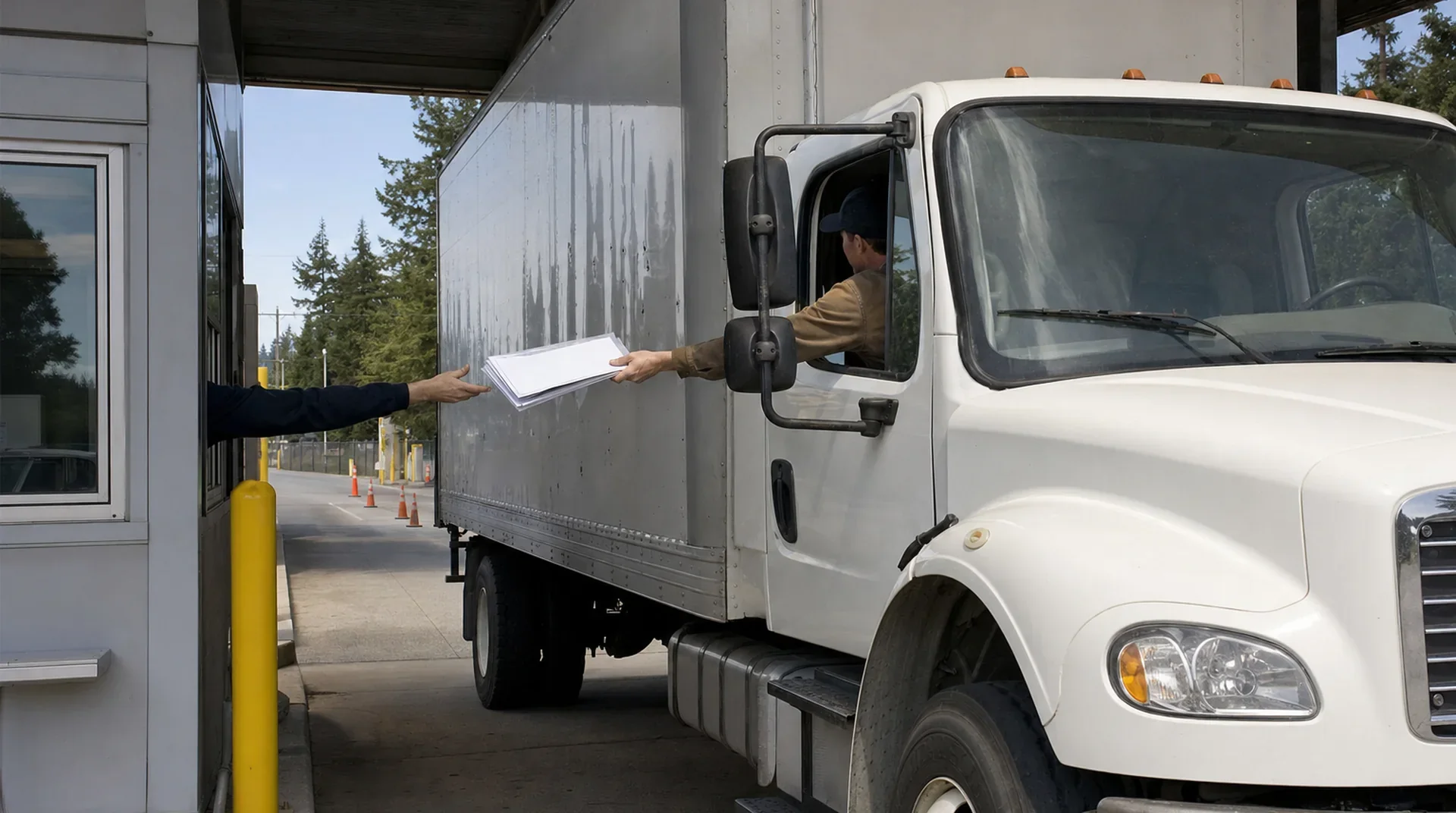
That is the part of a US-Canada crossing that shippers see least. The carrier knows its number. The customs broker knows the entry. The border officer sees both only when the driver hands over the paper. If the number on the barcode is not the number the broker filed against, the truck has arrived, but the release has not.
This page is about those numbers: what a PARS number and a PAPS number are, who creates each one, who files against it, and what the shipper owes each party before the truck rolls. What slows a crossing in general is covered in cross-border expedited freight between the US and Canada, and what an aircraft part needs to be eligible in Canada is covered in aerospace logistics. This page stays on the paperwork handoff.
What Are PARS and PAPS?
PARS and PAPS
PARS (Pre-Arrival Review System) is a CBSA service option that lets importers and customs brokers submit release documentation for commercial goods for review before or after arrival in Canada. PAPS (Pre-Arrival Processing System) is the CBP process for transmitting entry data electronically before a truck arrives in the United States, through the Automated Broker Interface.
The two systems solve the same problem from opposite sides of the border. Customs wants to know what is on the truck, and to have decided whether to release it, before the truck reaches the booth. The way both agencies connect the truck to the paperwork is a number that the carrier creates and the broker quotes.
| PARS (into Canada) | PAPS (into the United States) | |
|---|---|---|
| Agency | Canada Border Services Agency (CBSA) | U.S. Customs and Border Protection (CBP) |
| The number | Cargo control number (CCN): the carrier’s CBSA-issued carrier code followed by a unique shipment number the carrier chooses | Shipment control number (SCN): per CBP’s 2004 notice, the master bill of lading, airway bill or pro bill number the carrier provides |
| Who creates it | The carrier | The carrier |
| Who files the release or entry against it | The importer or the customs broker | The entry filer: the importer or its customs broker |
| What the carrier transmits separately | Highway cargo and conveyance data (eManifest) | Advance truck cargo information (ACE e-manifest) |
| What the driver presents | The PARS document with the bar-coded CCN and a handwritten conveyance reference number | Paperwork identifying the SCN; CBP’s 2003 rule says it will continue to support bar codes to identify PAPS shipments |
Who Creates the Number, and Who Files Against It?
The carrier creates the number on both sides. That surprises shippers who assume the broker issues it, and it is the root of most mismatches.
Into Canada. The CBSA says the carrier code “is combined with a unique shipment number (chosen by the carrier) to create a cargo control number”, and that the cargo control number is used in bar-code format. The first four characters are the carrier code. For a PARS shipment the word “PARS” must appear on the bar-coded label, and if the carrier puts “PARS” inside the number itself, it has to be in the bar code too. The CBSA’s own example is a PARS number of “1234PARS56789”: the cargo control number the carrier transmits electronically before arrival must then be exactly “1234PARS56789”, and the release documents must match it.
Into the United States. In its 2004 notice on the ACE truck manifest, CBP described PAPS as the process for transmitting entry data to CBP before the truck arrives, through the Automated Broker Interface, by the designated entry filer. It said: “For PAPS, the carrier will provide a Shipment Control Number (SCN)”, and “The SCN number provided by the carrier must match the number supplied by the entry filer on the entry.”
So the job splits three ways. The carrier creates the number and reports the truck and the cargo. The broker files the release or the entry against that number. The shipper, who holds the commercial invoice and knows who the broker is, is the one party in a position to put the two together.
What Does the Handoff Look Like Before the Truck Rolls?
On a clean crossing, the paperwork moves in a fixed order. Each step depends on the one before it.
- The shipper books the carrier and names the broker. The carrier needs to know who clears the shipment on the far side, and the broker needs to know a shipment is coming.
- The carrier assigns the number. A CCN with its PARS label for Canada, or an SCN for the United States. On the Canadian side the PARS label may go on the invoice or the bill of lading, and one label per shipment is enough.
- The invoice and the number reach the broker. The CBSA’s bar-coded label page says the invoice or bill of lading “must be sent to the broker at least two hours before the goods arrive in Canada.”
- The broker files. The release request goes to the CBSA, or the entry goes to CBP, quoting the carrier’s number.
- The carrier transmits its own data. The cargo and conveyance report to the CBSA, or the advance cargo information to CBP, quoting the same number.
- The driver presents the paper. At a Canadian port the officer scans the PARS label, and if the shipment is cleared, date-stamps the invoice or bill of lading and returns it to the driver as proof of clearance.
Step 3 is where shipments most often stall. The CBSA page describes the carrier sending the bar-coded invoice or bill of lading to the broker, but the commercial invoice starts with the shipper. Whoever sends it, agree in writing before pickup who is responsible for getting it to the broker, and by when.
How Much Lead Time Does Each Side Need?
There are two clocks on each crossing: one for the broker’s paperwork and one for the carrier’s electronic report. Both have to be met.
| Direction | What has to happen | Deadline | Source |
|---|---|---|---|
| Into Canada | PARS invoice or bill of lading sent to the broker | At least two hours before the goods arrive in Canada | CBSA, Cargo control and bar-coded labels |
| Into Canada | Highway cargo and conveyance data received and validated by the CBSA | Within 30 days and no later than one hour before arrival at the first port of arrival | CBSA Memorandum D3-4-2, para 81 |
| Into the United States | Advance truck cargo information received by CBP | No later than one hour before arrival, or 30 minutes for shipments moving under FAST | 19 CFR 123.92(a); CBP final rule of 5 December 2003 |
Two details matter. On the Canadian side, the CBSA accepts properly formatted messages received less than one hour before arrival, but flags them with an “insufficient review time” warning, and says monetary penalties under its AMPS regime may apply. On the US side, CBP’s 2004 notice said the one hour for ACE, or 30 minutes for FAST, is “measured from the time that CBP receives the final manifest submission”. A manifest amended at the last minute restarts the question of whether the deadline was met.
The 30-minute FAST window is not something a shipper can choose on the day. CBP’s 2004 notice tied it to a registered driver, a transponder, and both carrier and importer being C-TPAT participants. Plan on the one-hour window unless your carrier and broker have confirmed otherwise.
What Has to Match for the Crossing to Clear?
Most holds that come from paperwork, rather than from an examination, come from something that does not match. Check these before the truck leaves:
- The number, character for character. The number on the PARS barcode must be the CCN the carrier transmitted and the one on the broker’s release request. The SCN the carrier provides must be the number the entry filer puts on the US entry.
- The port. CBSA Memorandum D3-4-2 says carriers must make every effort to tell the importer or broker which crossing they intend to use. If the truck arrives at a port different from the port of release, the release cannot be effected there.
- A number used once. The CBSA says shipment numbers may not be repeated within three years, and that its systems reject duplicates. A PARS number and a non-PARS number with the same digits count as a duplicate.
- A real description. For US-bound cargo, 19 CFR 123.92(d) requires a precise description of the cargo or the six-digit Harmonized Tariff Schedule number, and says generic terms such as “FAK”, “general cargo” and “STC” are not acceptable.
- Accurate shipper facts. Under 19 CFR 123.92(c)(3), when the carrier transmits information it received from someone else and cannot reasonably verify it, CBP lets the carrier present it on the basis of what it reasonably believes to be true. In plain terms, the carrier’s report is only as good as what the shipper told it.
What Happens When a PARS Fails or the Data Is Late?
Failed PARS. The CBSA describes a failed PARS as a shipment whose release has not been processed by the time the carrier reaches the border. Memorandum D3-4-2 gives the examples of a release that is not on file or has been rejected. The shipment is then either released at the border under release with minimal documentation (RMD), or forwarded in bond to an inland office. To avoid a duplicate release, the same cargo control number is reused on a cargo control document, Form A8A(B), which the carrier must present as proof of report if it moves the goods in bond. Moving in bond depends on the carrier’s own bonding status, which is a question to ask before booking, not at the booth.
Late data into the United States. In its 2003 final rule, CBP said that where advance cargo information is not received in time, it may deny the permit to unlade, delay the release of the cargo until security screening is complete, and assess penalties or claims for liquidated damages. For a time-critical part, the delay is usually the cost that matters most.
Neither outcome is a customs decision about the goods. Both are about the paperwork arriving later than the truck, which is why the fix is on the timeline, not at the booth.
What Should a Shipper Send, and to Whom?
A short list, split by recipient. This is the part of the crossing that belongs to you.
| Send to | What | Why |
|---|---|---|
| The carrier | The broker’s name and contact on the clearing side; a precise description of the goods; piece count, weight and packaging; shipper and consignee names and addresses | The carrier’s electronic report is built from it, and the carrier needs to know whom to coordinate with |
| The customs broker | The commercial invoice, the carrier’s name, and the carrier’s PARS or PAPS number; the planned crossing and arrival time | The broker files the release or entry against the carrier’s number at the port the truck will actually use |
| Both | Any change to the pickup time, the crossing or the contents | A change on one side that is not made on the other is the most common way two numbers stop matching |
If you cannot say who the broker is, the shipment is not ready to book as a cross-border move. That is worth knowing before a dedicated truck is dispatched, not an hour from the line.
Where Does Vic’s Fit on a US-Canada Crossing?
Vic’s Freight runs dedicated, single-custody expedited ground between the US and Canada: one vehicle and one driver, with the documents moving with the load from pickup to delivery. We are not a customs broker and we do not file your entry. We coordinate the crossing with your team and your broker, so the number on our paperwork and the number on their filing are confirmed as the same number before the truck reaches the line.
What makes that work is the order of events above: broker named at booking, invoice to the broker ahead of the deadline, the crossing agreed. If you have a shipment to move across the border, send the lane, the goods and who clears them through our contact page, and we will build the move around the paperwork, not the other way round.
PARS and PAPS: Common Questions
What is the difference between PARS and PAPS?
PARS is the Canadian release option: the customs broker files a release with the CBSA against the carrier’s bar-coded cargo control number. PAPS is the US process: the entry filer transmits entry data to CBP before arrival against the carrier’s shipment control number. Both use a number the carrier creates.
Who provides the PARS or PAPS number?
The carrier. For Canada, the CBSA says the cargo control number is the carrier’s CBSA-issued carrier code plus a unique shipment number the carrier chooses. For the United States, CBP’s 2004 notice says the carrier provides the shipment control number, and the entry filer’s number must match it.
How far in advance does the PARS paperwork have to reach the broker?
The CBSA says the invoice or bill of lading must be sent to the broker at least two hours before the goods arrive in Canada. Separately, the carrier’s cargo and conveyance data must be received and validated by the CBSA no later than one hour before arrival.
How long before arrival does CBP need the truck manifest?
Under 19 CFR 123.92(a), CBP must receive the advance cargo information no later than one hour or 30 minutes before the truck reaches the first US port, depending on the system used. CBP’s 2003 final rule tied the 30-minute window to FAST shipments and one hour to other truck shipments.
What happens if a PARS fails at the border?
The shipment is released at the border under release with minimal documentation, or moved in bond to an inland office. The same cargo control number is reused on a cargo control document, Form A8A(B), which serves as proof of report if the goods move in bond.
Written by the Vic’s Freight operations desk. Verified 28.09.2026. Canadian requirements are from the CBSA pages “Cargo control and bar-coded labels” (modified 07.10.2024) and “Cargo Control Number (CCN)”, and from CBSA Memorandum D3-4-2, “Highway pre-arrival and reporting requirements” (dated 12.11.2025), all retrieved live. US requirements are from 19 CFR 123.92 in the title 19 edition of the eCFR dated 26.08.2026, and from CBP’s documents in the Federal Register: the final rule “Required Advance Electronic Presentation of Cargo Information” of 05.12.2003 and the ACE truck manifest test notice of 13.09.2004. This page states no customs fees, duties or penalty amounts, and it does not replace your customs broker. Nothing here is legal advice.