Trade Show Freight: Target Times, Marshalling Yards and Drayage Explained
Short answer
A trade show does not accept freight when it arrives. It accepts freight at an assigned target time, and to make that time a truck must first check into a marshalling yard, produce the paperwork and be called to the dock. Miss the target and the freight waits, sometimes a full day. The schedule therefore has to be built backwards from the target time, not forwards from your dock. Drayage — the general contractor’s charge to move freight from the dock to your booth — is separate from freight cost and is billed by weight, which is why the weight tickets matter as much as the arrival time.
What Is a Target Time, and Who Assigns It?
A target time is the window in which your specific booth’s freight is expected at the show. It is assigned by the show’s general service contractor — the company that runs the floor, the docks and the labour — and it is built into a floor-wide sequence so that the booths at the back of the hall are set before the aisles in front of them are blocked.
That sequencing is why the target is not negotiable in the way a normal delivery appointment is. It is not the receiver’s convenience; it is a dependency in someone else’s build order. Arriving early does not help, because the aisle you need may still be occupied. Arriving late is worse, because your slot has already been given to the next truck.
Targets are published in the exhibitor service manual along with the marshalling yard address and the paperwork requirements. Read it before booking a carrier, not after — it contains the constraints the whole schedule has to satisfy.
What Actually Happens at a Marshalling Yard?
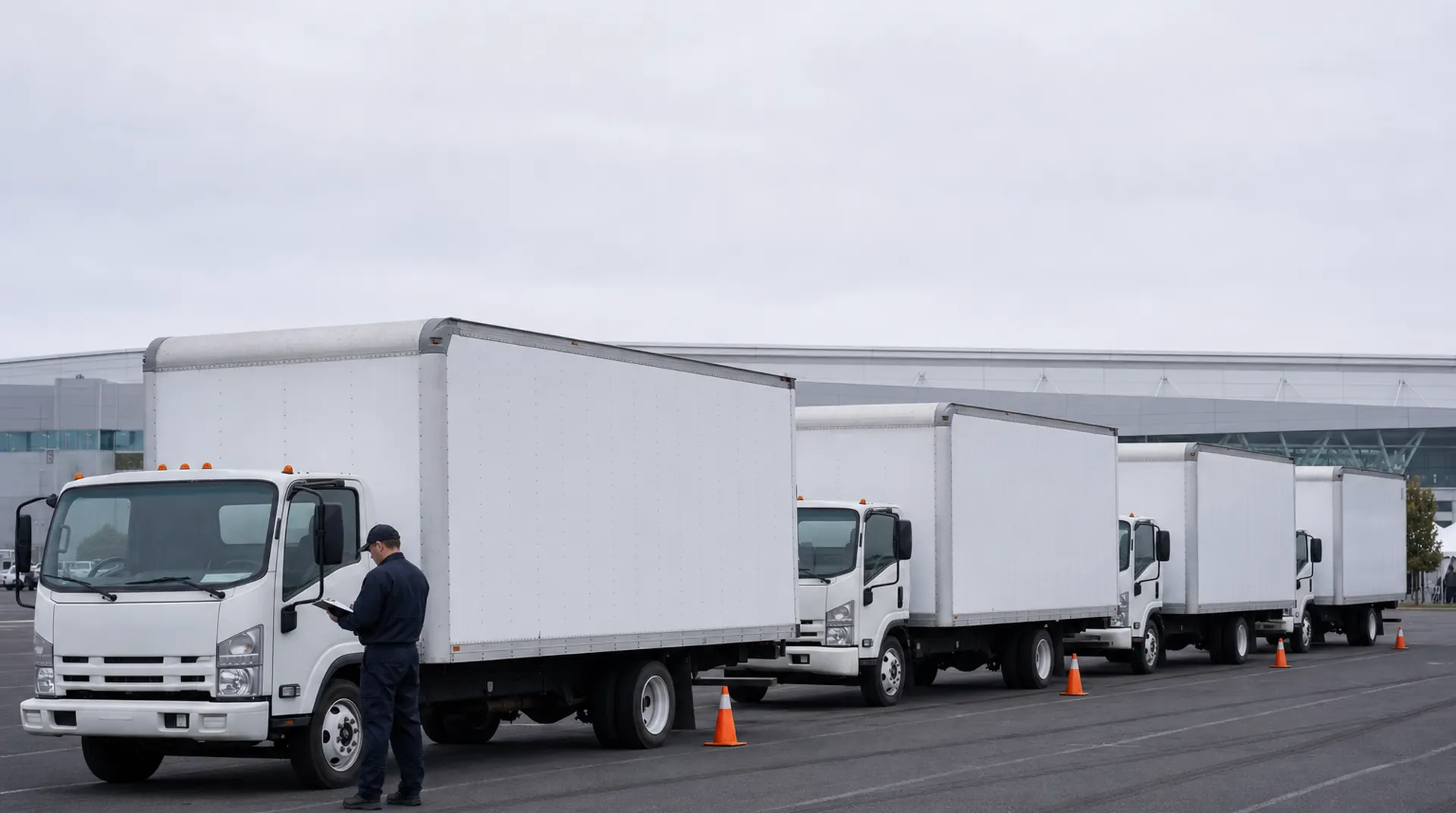
Large shows do not let trucks drive to the dock. They send them to a marshalling yard: a staging lot, often several miles from the venue, where trucks check in, hand over paperwork, are weighed, and then wait to be called forward in target order.
The sequence is roughly this. The driver arrives at the yard and checks in. The Material Handling Agreement and certified weight ticket are submitted. The truck is placed in the queue for its target. When the dock is ready, the yard calls the driver — by phone — and the truck is released to the venue.
Two things in that sequence trip up carriers who do not work shows regularly. The first is that the yard reaches the driver by phone; the general service contractor GES tells exhibitors explicitly to tell the driver to watch their phone in the yard, because that call is how the truck gets moved. A driver asleep in the bunk misses the release and drops down the queue.
The second is the weight ticket, and it is expensive.
How Is Drayage Calculated, and Why Does the Weight Ticket Matter?
Drayage — properly, material handling — is the general service contractor’s charge for taking your freight from the dock to your booth, storing your empty crates during the show, and bringing them back at the end. It is not part of your freight bill. It is billed separately, by the contractor, and it is frequently the larger of the two numbers.
It is calculated by weight. As EXHIBITOR magazine explains, material handling is billed by hundredweight, or CWT, with each piece of freight weighed and rounded up to the next 100 pounds — 212 pounds bills as 3 CWT, 489 pounds as 5 CWT. Dimensions usually do not enter into it unless an item is especially oversized.
Which brings us to the detail that costs exhibitors real money. The yard weighs the truck loaded on the way in. The driver is then supposed to return to the scale after unloading for a lightweight, so the difference gives your freight’s actual weight. GES warns that if the driver fails to go back over the scale, you may be charged the full weight of the truck as drayage. On a shared load or a large vehicle carrying a small booth, that is not a rounding error — it is a bill for freight that was never yours.
This is the clearest illustration of a general principle at shows: the cost is set by procedure, not by distance. Two identical booths shipped the same miles can differ by thousands of dollars purely on whether the paperwork and the scale runs were done correctly.
The Target-Time Backward Plan
Build the schedule from the target time backwards. Each step has a duration and a failure mode, and the failure modes compound forwards, so the only reliable way to plan is in reverse.
- Target time at the dock. The fixed point. Everything else is derived from it. Slips when: nothing — it does not move for you.
- Release from the marshalling yard. Allow for the queue, not just the check-in. On a busy move-in day this can be hours. Slips when: the driver misses the call, or paperwork is incomplete at check-in.
- Yard check-in and inbound weigh. Material Handling Agreement, certified weight ticket, booth number, hall, 24/7 contact. Slips when: the driver arrives without documents and is turned back to sort them out.
- Arrival at the yard. Plan to be there ahead of the target, with buffer. Slips when: the buffer was set to zero because the transit looked comfortable.
- Transit. Road time under hours-of-service limits, plus weather and traffic margin. Slips when: a single-driver run is booked for a distance that needs a team.
- Pickup at your facility. Loading, securing, and the certified weigh before departure. Slips when: the booth is not crated on time and the driver waits.
- Crate-ready deadline at the shop. The true start of the chain, and the one date entirely under your control. Slips when: graphics or product arrive late and everything downstream absorbs it.
Work through those seven in reverse and you get a crate-ready date. If that date is already behind you, the answer is not a faster truck — it is the advance warehouse, or a different move-in strategy.
Advance Warehouse or Direct to Show?
The fork sits before everything above, and it changes which risks you are carrying.
Advance warehouse. Freight ships weeks ahead to a receiving warehouse the contractor operates, is held, and is delivered to your booth by the contractor during move-in. You lose the ability to ship late. You gain the removal of every timing risk on the list — no target, no yard, no queue. The contractor’s material-handling charges cover the operation of that warehouse, so the service is not free, but the schedule risk largely goes away.
Direct to show. Freight arrives at the venue during your assigned target. You keep your booth in your own hands until the last moment, which matters if product, graphics or samples are still being finished. You take on the target, the yard and the queue.
The honest rule: ship to the advance warehouse unless something in the booth is not going to exist in time. Direct-to-show is a way of buying more preparation days, and the price of those days is schedule risk on move-in morning. That is a reasonable trade when you need it and an unnecessary one when you do not.
What Goes Wrong, and Where
- A carrier that does not work shows. Standard freight operations treat a delivery window as an appointment to negotiate. A target is not that, and a driver who tries to negotiate at the yard loses the slot. Book someone who has been through a marshalling yard before — the point of dedicated, exclusive-use transport here is control over exactly this.
- No lightweight run. Covered above. Confirm with the carrier, in writing, that the driver will re-scale after unloading.
- Consolidated freight. If your booth shares a trailer with other shipments, your target competes with theirs. Exclusive use removes the conflict.
- Empties. Crates must be labelled with empty stickers and removed before the show opens, and they come back after the floor closes — which is why outbound is never immediate. Plan the return trip around it, not against it.
- Outbound drift. At close, if your carrier has not checked in by the show’s deadline, freight is typically forced onto the show’s house carrier at its rates. The outbound appointment deserves the same attention as the inbound one, and usually gets none.
- High-value or fragile exhibits. Handling at a show is heavy and fast. Anything that cannot take it needs white-glove handling arranged in advance rather than discovered at the dock.
For the timing side of move-in specifically, see our note on the trade show move-in window.
Key Takeaways
- A target time is a position in the show’s build sequence, not a delivery appointment. It does not move, and early is not better than on time.
- Large shows stage trucks at a marshalling yard and call drivers forward by phone. A missed call costs a place in the queue.
- Drayage is billed by hundredweight, rounded up to the next 100 pounds, and is charged separately from freight by the general service contractor.
- If the driver does not return to the scale for a lightweight, you can be billed drayage on the full weight of the truck.
- Ship to the advance warehouse unless part of the booth genuinely will not be ready. Direct-to-show buys preparation days and pays for them in schedule risk.
- Build the schedule backwards from the target time through the yard, the weigh-in, transit and pickup, to a crate-ready date at your shop.
Trade Show Freight: Common Questions
What is a target time for trade show freight?
A target time is the specific window assigned to your booth for delivering freight to the show. It is set by the general service contractor as part of a floor-wide move-in sequence, so booths at the back of the hall are targeted before the ones in front of them. Because it is a dependency in the build order rather than a convenience appointment, arriving early does not gain you anything and arriving late usually means waiting until a gap opens, which can be the following day.
What happens at a trade show marshalling yard?
The marshalling yard is a staging lot, often several miles from the venue, where trucks check in before being allowed to the dock. The driver submits the Material Handling Agreement and certified weight ticket, the truck is weighed and queued in target order, and the yard calls the driver by phone when the dock is ready. Missing that call, or arriving without complete paperwork, sends the truck to the back of the queue.
How is trade show drayage calculated?
Drayage, or material handling, is billed by hundredweight (CWT). Each piece of freight is weighed and rounded up to the next 100 pounds, so 212 pounds bills as 3 CWT and 489 pounds as 5 CWT. Dimensions are usually not a factor unless an item is especially oversized. The charge is levied by the general service contractor, is separate from your freight bill, and covers moving freight from the dock to the booth, storing empty crates during the show and returning them afterwards.
Should I ship to the advance warehouse or direct to show site?
Ship to the advance warehouse unless something in the booth genuinely will not be finished in time. The advance warehouse removes the target time, the marshalling yard and the move-in queue from your risk entirely, at the cost of shipping earlier. Direct-to-show keeps the booth in your hands for longer, which is worth it when product or graphics are still being completed, but it transfers all the move-in timing risk onto the morning of the show.
Shipping to a Show With a Target Time?
Vic’s Freight runs dedicated vehicles to trade shows and production events across the US and Canada — drivers who know the yard, the paperwork and the scale.