Emergency Freight Services: The Recovery Move When the Plan Breaks
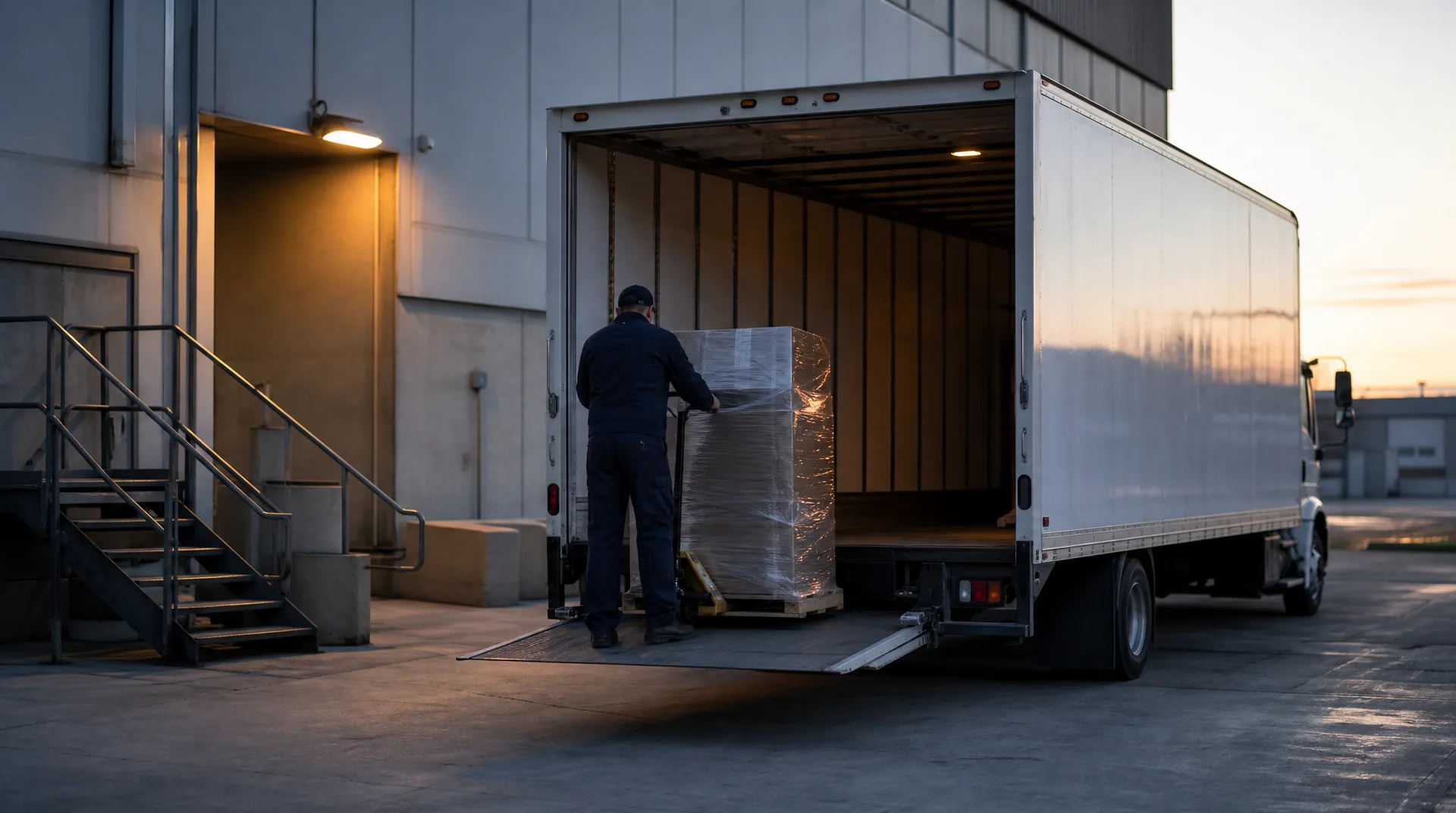
Nobody plans for emergency freight. It shows up when the plan you already had falls apart: a carrier that failed, a missed cutoff, a shipment that dropped off the standard network with a deadline still attached.
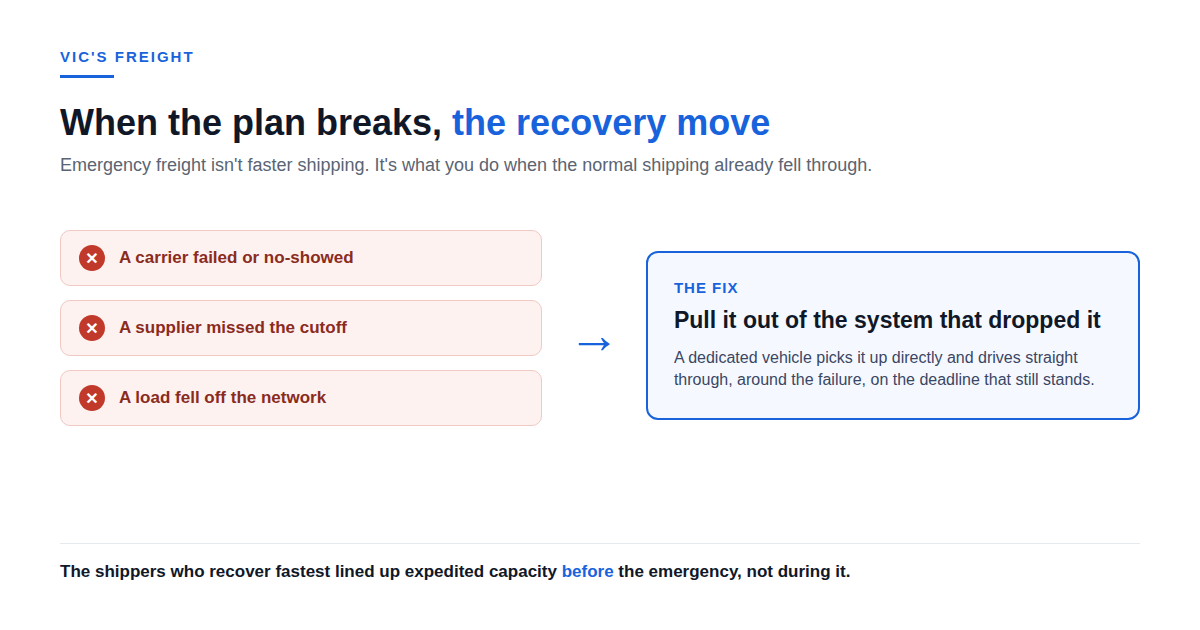
That is the real difference. Emergency freight is not a faster version of normal shipping. It is the recovery move when the normal shipping already broke, and the clock did not stop just because your first plan did.
What usually triggers it
Emergencies tend to come from the same handful of failures:
- A carrier fell through, cancelled, or is not going to make the window they promised.
- A supplier missed the cutoff and the shipment is about to be a day late.
- A load fell off the standard network somewhere in the middle and nobody can say when it moves.
- Something downstream, a line, a job, a customer, is now waiting on freight that is not going to arrive on the original plan.
The recovery move
When the first plan breaks, the fix is to take the freight out of the system that dropped it. A dedicated vehicle picks it up directly and runs it straight through, around the network that failed, on the deadline that still stands. No terminals, no waiting for a lane, no more handoffs where it can slip again. The whole point is to stop the delay from compounding, which is why expedited is so often the backup plan when the normal one falls through.
The first fifteen minutes
The single biggest cause of a slow recovery is not carrier availability. It is that nobody can answer basic questions about the freight, so the truck cannot be assigned. Five things decide how fast this moves, and you can gather all of them while you are still on hold:
- Where the freight physically is right now. Not the origin on the paperwork. The actual address it can be collected from this afternoon. On a load that fell off the network mid-route, that is often a terminal nobody has named yet, and finding out is the long pole.
- Who can release it. A pickup nobody is authorised to hand over is not a pickup. If the failed carrier is holding the freight, someone has to agree to give it back, and that conversation takes longer than the drive.
- Piece count, dimensions and weight. These pick the vehicle. A guess that turns out wrong sends the wrong truck and costs you a second dispatch you do not have time for.
- The real deadline, and what breaks after it. There is a difference between a delivery someone would prefer tomorrow and a line that stops at 6 a.m. Only one of those justifies a team run, and the plan is built backwards from it.
- Receiving hours at the far end. Arriving at 3 a.m. to a dock that opens at seven has recovered nothing.
Having those five ready turns the call into a dispatch. Not having them turns it into an investigation while the clock runs.
Whether the deadline is still reachable
Before anyone promises a time, the distance has to fit inside the hours available, and those hours are set by regulation rather than effort. A property-carrying driver may drive up to 11 hours after 10 consecutive hours off duty, and those hours must fall within a 14-hour on-duty window, with a 30-minute break required after 8 cumulative hours of driving.
In practice that means one driver covers roughly 600 road miles in a day. Beyond that the truck stops for ten hours, and no amount of urgency changes it.
So on a long recovery there are three honest answers, and a carrier worth using will give you one of them rather than a hopeful time:
- One driver makes it, because the remaining distance fits the remaining hours.
- It needs a team, two drivers alternating so the vehicle never stops, which roughly doubles the ground a day can cover and costs accordingly.
- Ground cannot make it at all, and the conversation has to change to what else is possible or what the deadline really is.
That third answer is worth more than a truck that leaves and misses, because you can still act on it. It is also less common than people expect: over a surprising range of distances, a dedicated vehicle that leaves now beats a flight that leaves tonight, for reasons laid out in when ground is actually faster than air.
Set it up before you need it
The shippers who recover fastest are the ones who lined up expedited capacity before the emergency, not during it. Knowing which carrier to call, confirming they control their own trucks, and setting tracking expectations up front turns a scramble into a phone call. Treat emergency freight as a standing plan, and the bad day stays a small one. The questions to settle in advance are the same ones that are hard to ask under pressure, and they are collected in how to choose an expedited carrier before you need one.
What this looks like in practice
- A carrier no-shows on a time-critical load, and a dedicated van is rolling before the missed pickup becomes a missed deadline.
- A supplier misses the cutoff, so the shipment is picked up directly and put back on schedule around the delay.
- A blown shipment stuck in the network is pulled out and driven straight through to make the window it still has to hit.
After the truck arrives
An emergency that gets recovered and never examined tends to come back. Two questions are worth asking once the freight is delivered: what was the actual point of failure, and how late was it noticed. Most emergency runs are not caused by the failure itself but by the hours between the failure and someone finding out about it. Shortening that gap is usually cheaper than the truck.
If the same route keeps generating emergencies, that is not a series of accidents. It is a lane that needs committed capacity rather than a repeated rescue.
Where Vic’s fits
Vic’s runs dedicated ground across the US and Canada, dispatched around the clock, kept in one set of hands from pickup to delivery. When a plan breaks and the clock is still running, we pick the freight up directly and drive it straight to where it has to be. If the deadline does not fit the distance, we will say so on the first call.
Get an instant quote. Tell us what broke and the deadline you are still holding, and we will get the shipment back on track.